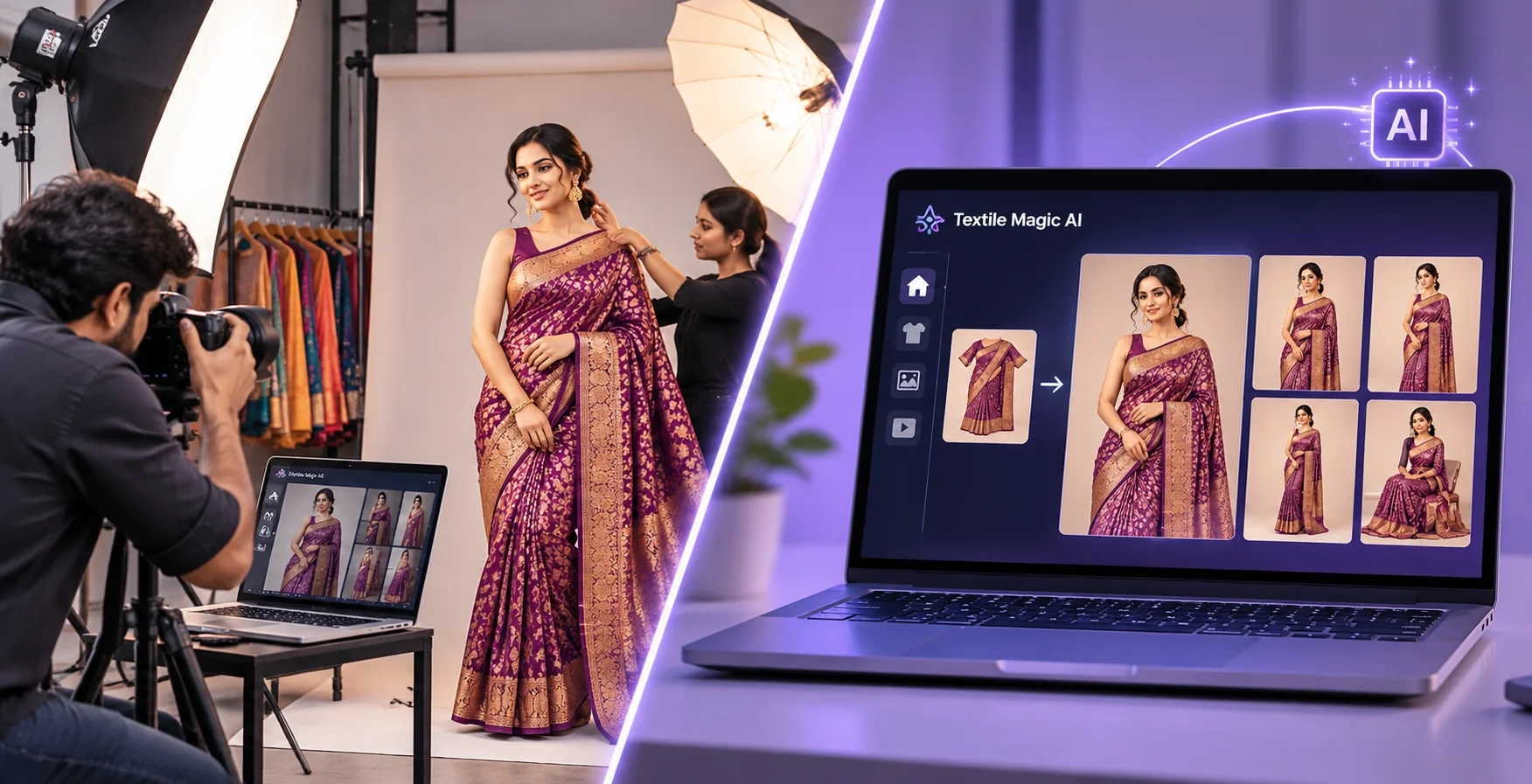
Running a clothing business is not just about selling beautiful products. You also need beautiful product photos.
Whether you sell sarees in Surat, kurtis in Jaipur, dresses in Mumbai, or clothing through Shopify, good images help customers understand what they are buying.
But professional fashion photography can become expensive.
You may need a photographer, model, studio, makeup artist, lighting equipment, and editing team. When you launch new collections regularly, these expenses can keep increasing.
What if you could create professional-looking model photos using your existing clothing images?
That is where Textile Magic AI comes in.
AI fashion photography offers a different way to produce catalogue images without organizing a physical photoshoot for every product.
But is AI really cheaper? Can it deliver professional quality? And should fashion brands stop using traditional photography?
Let's compare the real differences in cost, time, image quality, and business value.
1. What Is a Traditional Fashion Photoshoot?
A traditional fashion photoshoot involves taking photographs of real clothing using a camera, photographer, models, and a physical location.
For example, imagine a Surat saree manufacturer launching 100 new saree designs.
To create a professional catalogue, the manufacturer may need to arrange:
-
Models and garment styling
-
Photographer and photography equipment
-
Studio or suitable location
-
Makeup, draping, and lighting
-
Photo selection and editing
-
Final images for websites and marketplaces
Every garment needs to be prepared, worn, photographed, and checked.
Traditional photography gives businesses direct control over the actual garment, model, fabric movement, and physical details.
However, producing large catalogues can require significant planning and coordination.
For small businesses, these costs can become difficult to manage.
2. What Is Textile Magic AI?
Textile Magic AI is an AI-powered fashion content platform designed to help clothing sellers create model images, garment visualizations, catalogues, and short fashion videos.
Instead of arranging a complete studio shoot, businesses can upload clothing references and generate digital fashion visuals.
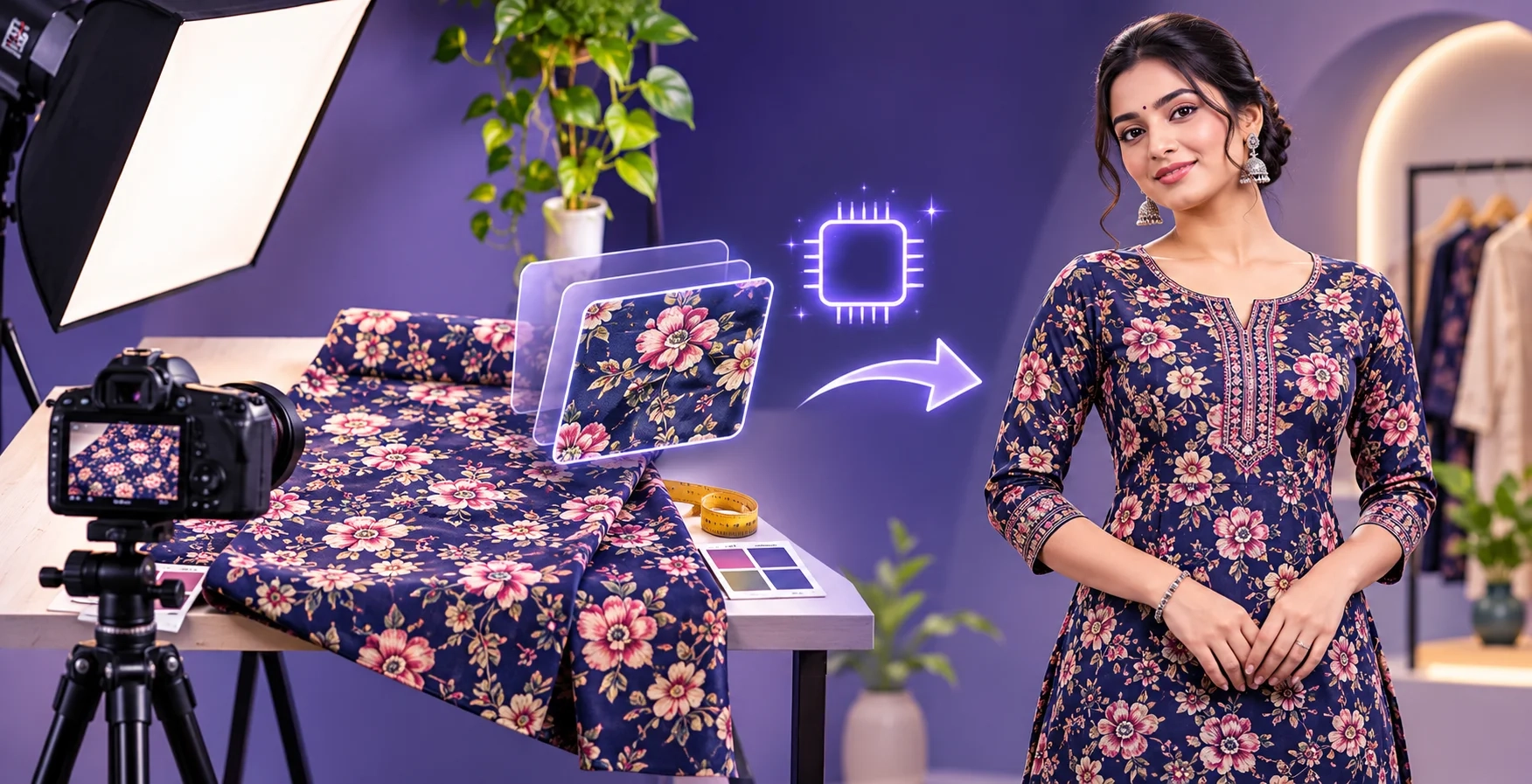
For example, a clothing seller can upload a kurti photo, select a model and studio style, and generate different catalogue poses.
The platform provides tools such as:
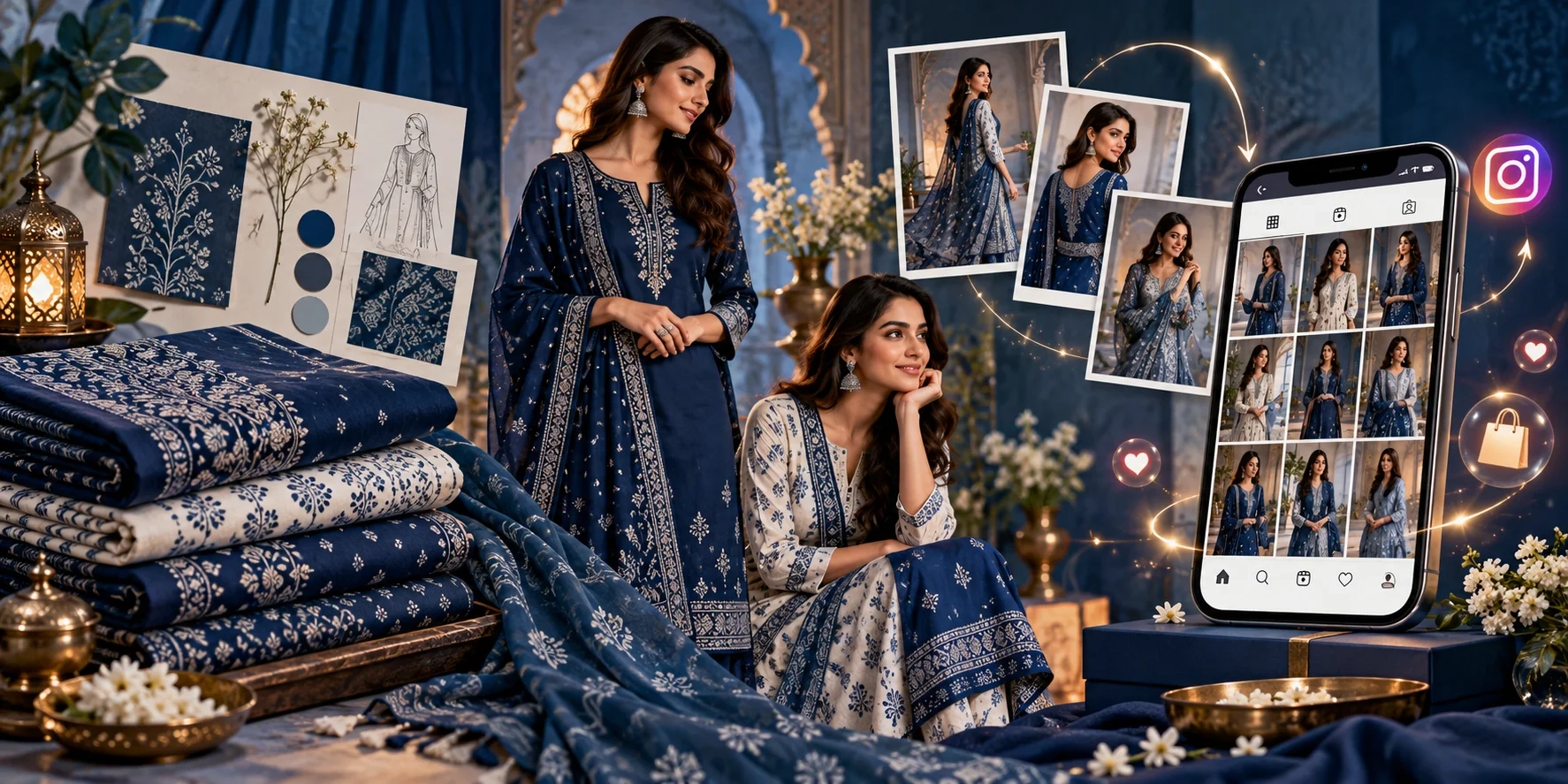
AI Catalogue Generator: Create multiple model poses and viewing angles from clothing references.
Fabric to Garment: Visualize how a fabric design could look when made into a kurti, dress, shirt, or another garment.
AI Video Studio: Turn selected clothing images into short fashion videos.
The purpose is to make fashion content creation more accessible, especially for businesses managing large collections.
AI-generated images still need human review to ensure that the real garment's colours, prints, and construction remain accurate.
3. Traditional Photoshoot vs Textile Magic AI: Cost Comparison
Cost is one of the biggest differences between traditional photoshoots and AI-generated fashion imagery.
A traditional photoshoot may include separate expenses for models, photography, styling, studio rental, editing, and transportation.
A photography studio may also offer an all-inclusive package.
Textile Magic AI uses a credit-based payment system, where the cost depends on the selected generation workflow and the number of images produced.
Cost comparison table
|
Factor |
Traditional photoshoot |
Textile Magic AI |
|---|---|---|
|
Photographer |
Usually required |
No physical photographer required for generation |
|
Model |
Physical model or mannequin |
Digital model visuals |
|
Studio |
Often required |
Digital background options |
|
Lighting |
Physical equipment |
AI-generated lighting |
|
Editing |
Retouching may be charged separately |
Review and regeneration may be needed |
|
Additional poses |
Additional shooting or editing |
Additional generation credits |
|
Bulk products |
Requires more production work |
Can generate from prepared references |
Example: Creating 150 saree catalogue images
Imagine a textile manufacturer needs three catalogue images for each of 50 sarees.
That means 150 finished images.
For illustration, suppose a photography studio quotes ₹750 per saree for three images.
Traditional studio example
₹37,500
50 sarees × ₹750
AI pack example
₹1,299
Advertised capacity: approximately 160 looks
Illustrative headline saving: ₹36,201, approximately 96.5%, before retries, image checking, staff time, or other production expenses. The outputs and services are not fully equivalent.
The ₹1,299 example uses the publicly listed Brand Growth pack on the Textile Magic AI pricing page.
Pay-As-You-Go Credits+1
The actual studio price may be higher or lower depending on the photographer, location, garment complexity, and included services.
For businesses generating hundreds of catalogue images, reducing physical production requirements can lead to significant savings.
But cost alone should not decide which method you choose. The images must also represent the real products accurately.
4. Time Comparison: Which Method Is Faster?
Time is extremely important for fashion businesses.
Fashion trends change quickly. A new design may become popular on Instagram, a festival collection may need an urgent launch, or a wholesaler may need to send catalogue images to buyers.
Traditional photography requires scheduling.
First, the clothes must be ready. Then, the photographer, model, and location must be available. After the photoshoot, images may need editing and approval.
A catalogue project can therefore take several days or longer, depending on the workload.
AI photography removes much of this scheduling process.
With Textile Magic AI, you can prepare garment photos, upload references, choose poses, and start generating without booking a physical studio.
The platform states that typical catalogue generations take around 30–60 seconds per reference. Actual completion times vary, and the total workflow includes uploads, reviews, and possible retries.
Pay-As-You-Go Credits+1
That means AI is especially useful when your business needs new content frequently.
For example, a boutique launching ten kurtis this week can prepare model visuals without arranging ten separate physical shoots.
The biggest benefit is not only faster image generation. It is the ability to move from a new product idea to a visual catalogue with fewer production dependencies.
5. Image Quality: Can AI Compete With Professional Photography?
This is the most important question.
Customers expect beautiful images, but they also expect the product they receive to match the product they saw online.
Where traditional photography performs better
Real photography captures the actual garment.
A professional photographer can show embroidery, fabric transparency, texture, stitching, colour, and natural movement.
This is especially important for luxury sarees, bridal lehengas, expensive designer clothing, and products where exact fit matters.
Where Textile Magic AI performs well
AI is useful for creating consistent presentation styles across large collections.
A brand can generate different poses, backgrounds, and catalogue compositions without rebuilding a physical studio for every variation.
It can also explore editorial concepts before spending money on a major campaign.
However, AI may occasionally change a print, embroidery pattern, neckline, sleeve, or colour.
That means AI-generated images should always be compared with original garment photographs.
The best product image is not simply the most attractive image. It is the image that helps customers understand the real product.
For many brands, combining real product-detail photography with carefully reviewed AI catalogue images offers a practical balance.
6. Why Surat Textile Manufacturers Should Consider AI Photography
Surat is an important textile production and trading hub in India.
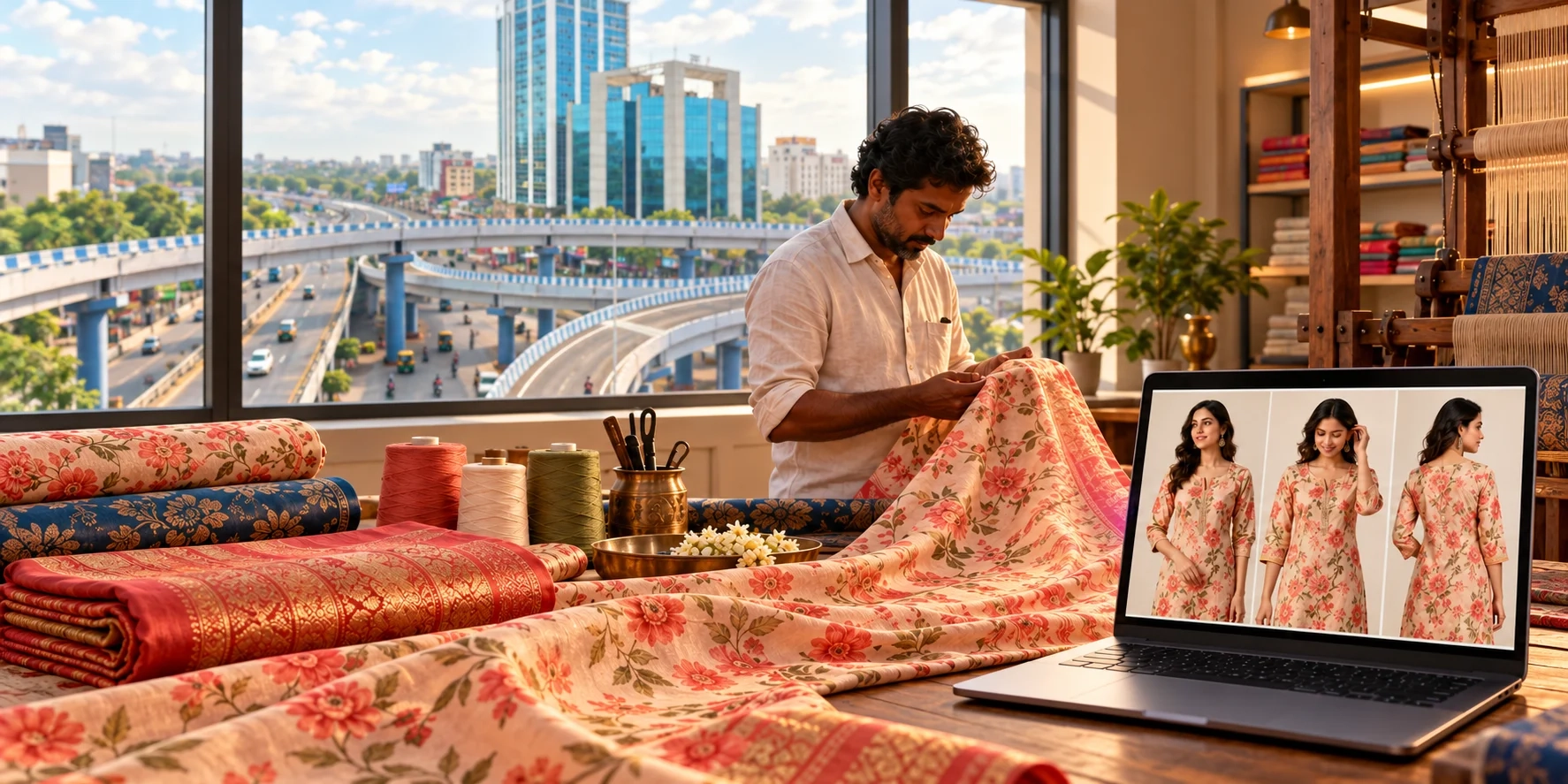
Many local businesses sell sarees, dress materials, kurtis, and fabrics through wholesale networks, online stores, and social media.
A manufacturer may have hundreds of designs in different colours and prints.
Creating physical model photographs for every design can be expensive and time-consuming.
AI catalogue generation can help businesses prepare digital presentations more efficiently.
Consider a Surat wholesaler who wants to send new saree designs to buyers in Mumbai, Delhi, or international markets.
Instead of waiting for a complete studio catalogue, the seller can create reviewed model visuals from suitable garment references.
This can help with product previews, buyer presentations, and early marketing.
AI can also help Ahmedabad garment manufacturers, Jaipur ethnic-wear sellers, and Mumbai fashion brands manage frequently changing collections.
International sellers targeting the UAE, UK, and USA can explore different creative backgrounds and model presentations for their audiences.
The key is to match the presentation to the intended market while keeping the garment itself accurate.
7. How to Create a Fashion Catalogue Using Textile Magic AI
You do not need advanced photography knowledge to begin.
Here is a simple workflow.
RIDHI-Pure Cotton Handloom Yellow With Blue Design Suit – Sanskruti
Step 1: Prepare your clothing photo
Take a clear, well-lit picture of the saree, kurti, shirt, or dress. Include additional views when prints, borders, or garment details need to be preserved.
Buy Beige Cotton Silk Embroidered Long Kurta for Women Online at Fabindia | 20230444
Step 2: Select your model and background
Open the AI Catalogue Generator. Upload the model and garment references, then select a background and lighting style.
Beige Floral Kurti – house of isa
Step 3: Generate multiple poses
Choose front-facing, side-angle, walking, seated, or detail-focused poses. The catalogue tool supports up to six poses in one generation setup.
Aakrithi | Cinematic Artisanal Boutique
Step 4: Check product accuracy
Compare every generated image with your real garment. Verify colour, print placement, stitching, borders, fit, and other important details.
CIELO || Fashion branding Website by Shimaa Mohamed on Dribbble
Step 5: Publish your approved catalogue
Download suitable images and prepare them for your Shopify store, Instagram page, wholesale catalogue, or other sales channel.
If you have a fabric design rather than a finished garment, explore the Fabric to Garment AI tool to create a design visualization before production.
8. Which Photography Method Is Better for Ecommerce?
The answer depends on your business.
Traditional photography is often better for luxury campaigns, detailed fabric demonstrations, and products requiring precise physical representation.
AI catalogue generation can be useful for growing businesses that want more images, faster creative testing, and fewer scheduling requirements.
For Shopify sellers, the ideal product gallery might include a real garment close-up, a verified front view, a side view, and carefully reviewed lifestyle imagery.
Product consistency matters across all channels.
For example, a customer who sees a blue saree on Instagram should not find a noticeably different shade or border design on the product page.
Accurate images help shoppers make informed purchasing decisions.
AI can improve your production workflow, but it should not replace product quality control.
9. SEO Benefits of Better Fashion Product Images
Product images can also support search visibility.
Google explains that descriptive image filenames, useful alt text, relevant page content, and high-quality images help search engines understand visual content.
Google for Developers
For example, instead of uploading a file named IMG001.jpg, a clothing seller could use:
blue-cotton-kurti-front-view.jpg
A useful image description might be:
Indian model wearing a blue cotton kurti with white floral print, shown from the front.
Avoid repeating keywords unnaturally.
Fashion brands should also compress images appropriately, add clear product descriptions, and use relevant category pages.
These steps help create a better shopping experience while supporting discoverability through Google Search and Google Images.
You can follow Google's official image SEO guidelines for further recommendations.
10. Can AI Replace Traditional Fashion Photoshoots Completely?
Not always.
AI can replace certain production tasks, especially repetitive catalogue generation and creative previews.
But traditional photography still provides valuable evidence of how a real product looks and behaves.
For clothing brands, a hybrid approach can be effective.
Photograph a few important products professionally, capture authentic fabric close-ups, and use AI for suitable supplementary catalogue visuals.
This approach helps businesses control costs without sacrificing accuracy.
Instead of asking whether AI will eliminate photographers, businesses should ask which parts of their visual workflow can be made faster and more affordable.
That creates a more useful long-term strategy.
Frequently Asked Questions
Is Textile Magic AI cheaper than a traditional photoshoot?
It can be significantly cheaper for many catalogue workflows because businesses do not need a separate physical studio, model, and photographer for every generated image. Actual savings depend on credit usage, retries, checking time, and studio quotations.
Can I generate saree catalogue images using AI?
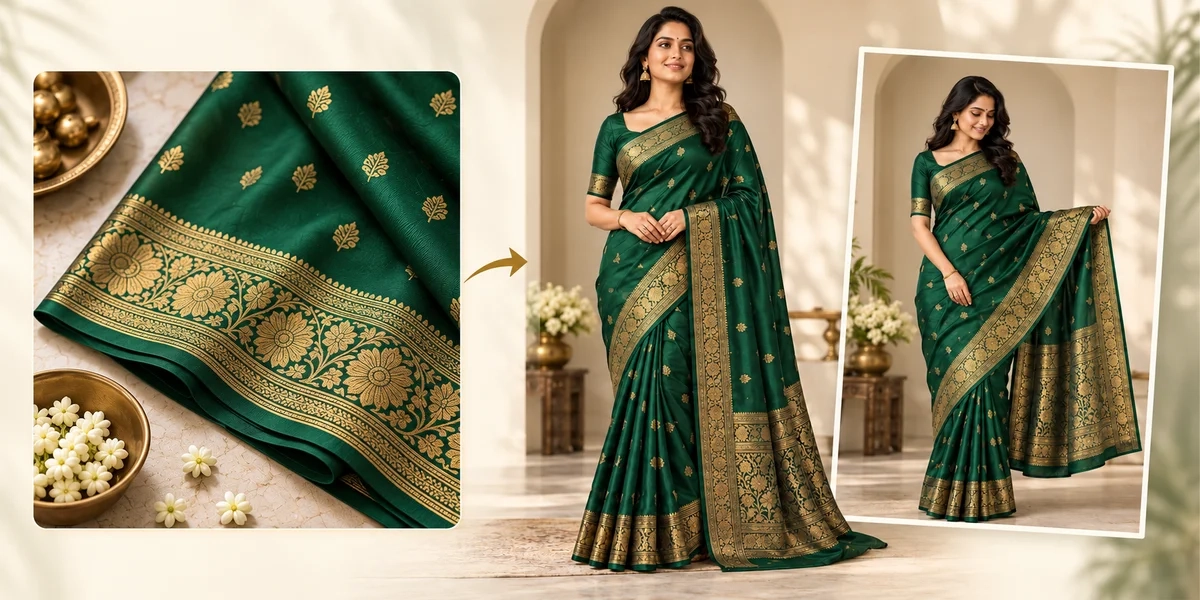
Yes. With suitable saree and model references, you can create different catalogue poses. Always check pallu placement, borders, colour, and embroidery against the original saree.
Is AI photography suitable for Shopify stores?
Yes, reviewed AI-generated fashion imagery can be useful for Shopify product presentations. Real product photos remain valuable for accurately showing fabric, construction, and fit.
Can Surat textile wholesalers use AI for bulk catalogues?
Yes. AI catalogue workflows can help wholesalers prepare presentations for large clothing collections, provided every output is checked before sharing it with buyers.
Do I need to hire a model to use Textile Magic AI?
You do not need to arrange a new physical model shoot for every generated catalogue image. The platform supports model reference images and AI-assisted visual creation.
Final Verdict: Traditional Photoshoot or Textile Magic AI?
Traditional photoshoots and AI fashion photography both have advantages.
Traditional photography gives businesses physical control over garments, lighting, and authentic fabric details.
Textile Magic AI provides a more flexible way to create catalogue visuals, explore creative variations, and reduce the need for repeated physical shoots.
For small boutiques, growing Shopify stores, and high-volume textile manufacturers, AI can be a valuable addition to the product photography workflow.
The smartest choice is not always to replace traditional photography completely. It is to use the right method for the right product.
Want to see how your clothing collection could look with AI?
Visit Textile Magic AI, upload suitable garment references, and explore professional-style catalogue creation.
Create More, Shoot Less.